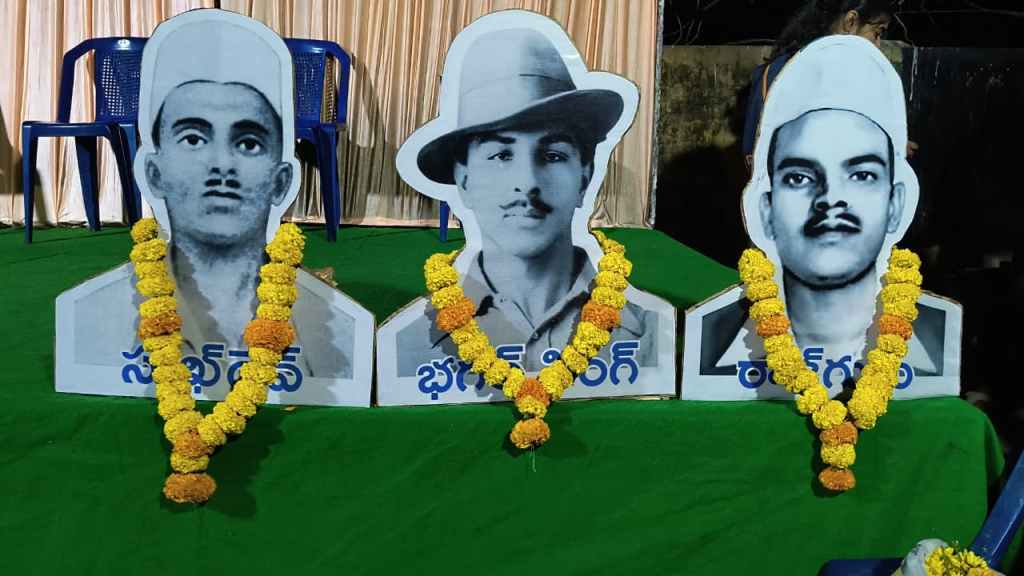
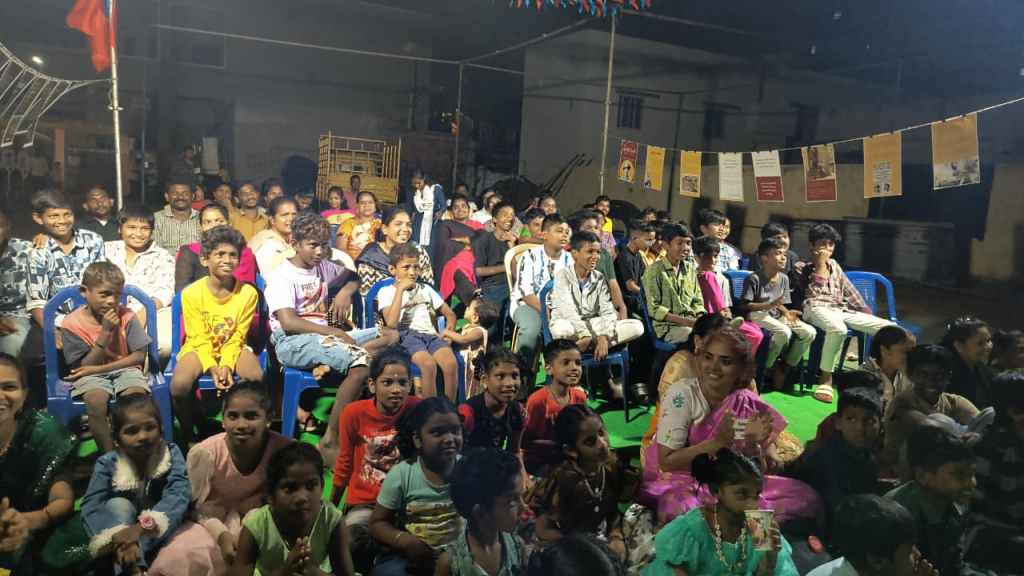
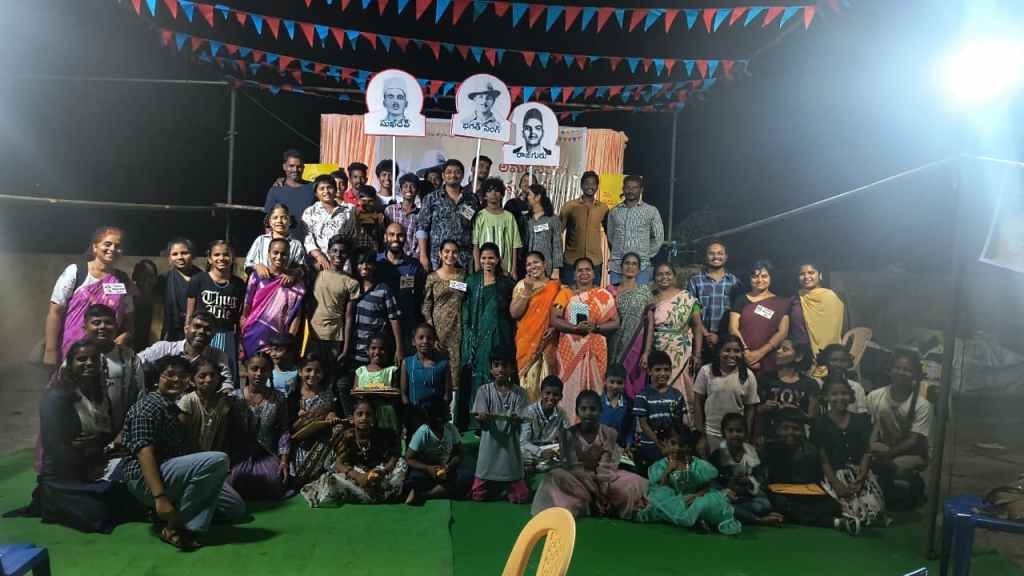
As Teja akka stood on the stage under the lights in the night, for me, it was like watching a beloved celebrity. “They say Bhagat Singh is an impulsive revolutionary,” she was saying, blazing like fire in her maroon saree. “But is he just that? Why does popular narrative portray him only as an impulsive, aggressive, and violent leader? He was more than that. He was a political thinker, a philosopher.” She stopped. She eyed the crowd. There were about fifty children seated on the ground and another fifty adults sitting in chairs. The breeze was light, and the hanging posters around the little arena of this meeting were fluttering gracefully—showcasing the lives of Bhagat Singh, Raj Guru, and Sukh Dev—whose death anniversary the Shahid Bhagat Singh Library of Vizag was “celebrating” that night in the fishermen colony of Jaalari Peta in Vizag. The remark of “celebration” was specially mentioned by Sujan, the young, soft-spoken, semi-saintly leader of the Shahid Bhagat Singh Library of Jaalari Peta, Vizag. As Teja akka eyed the crowd for a long moment, I hoped her eyes would meet mine. I thought I could express my admiration for her while she was on the stage, but nah, she didn’t catch me. To my surprise, she abruptly ended her speech by making a casual remark on how we need to learn history to really understand the narratives that are made about historical figures, only what is expected of a history lecturer like her. I clapped enthusiastically, as did J.P., the godfather or whatever, for all multitudinous socialist activities that happen in Vizag under the party banner of the N.S.P.—New Socialist Praxis.
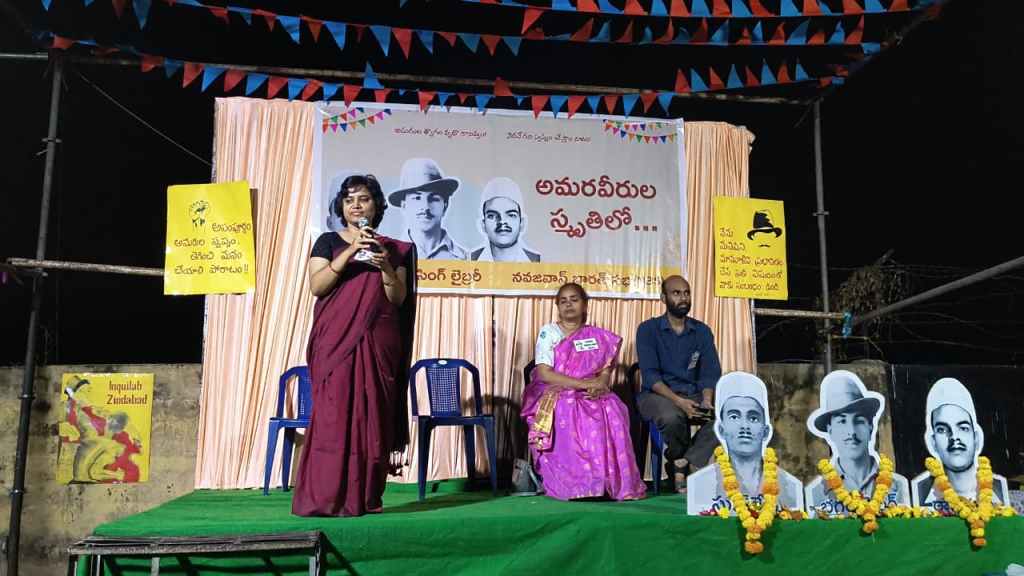
J.P. might be very much against the ‘Godfather’ remark, but we will come to it later. Next was Aruna ma’am, and I need to hold this for a moment, take a sip of water, and then continue. She looks like Arundhati Roy. There is no way I can look at her any other way.
The first time I met her was at the library, when I was ambushed/tasked with being the judge of this singing competition held to commemorate the death anniversary of this revolutionary trio. I was sitting on a high stool, probably looking like a clown beside this red-haired, aura-farming woman. She didn’t do anything in particular. She entered the room, her demeanour was so calm, and her presence was so gentle, yet powerful, and the way she spoke to each person actually taught me some important communication skills.
We sat in the cramped hall of this library, and one after the other, people walked in—mostly students and some members of the general public—and they introduced themselves to us, and then sang their song. I was just paying attention to the song, but Aruna ma’am was not so simple. After each song, she spoke with them in her calm voice, asking them why they had chosen that particular piece, and connecting the piece to their own lives on the margins. The contexts were so sleek; I saw surprise of recognition on the faces of these participants quite often. And then they got excited and related the song to their lives on their own. They should have been singing these songs for years, no, but probably this was the first time they had seen them that way.
After two or three participants, she looked at me, and as if she had known me for the past three years, she said something like, “This is not just about the competition, right? It is about them being able to understand and reflect on their lives.” I smiled, nodded, and totally agreed with her. After that, once or twice, I tried to do what she was doing, just to self-demonstrate how bad I was at that.
She was on the stage, and I naturally was eager. There were three boys in the row before ours, and they were in their own world among all of that, being playfully violent with each other. I wished they knew how precious these little speeches were.
Aruna ma’am, apart from being a flame-haired exotic, is a journalist—or so I had inferred. I don’t know anything about any of them. Not much, at least. I think she used to work as a big-time journalist in some big-time media house, but, vexed with the way things work, had resigned to be an indie, or maybe a local. I inferred this from one of the casual comments she had made after the Vizag Cinephiles screening of the film Wag the Dog—De Niro’s political satire—which she had thoroughly enjoyed recently.
On the stage that night, with the lights doing amazing things with her red hair, she talked straight into the hearts of these women who already admired her so much. In the library, she takes up one of the most important roles. Every afternoon, she teaches Telugu and English, both reading and writing, to the women of that fishermen’s colony. She encourages everyone to come there to learn and better their lives. Though the classes were only meant for the children in the beginning, they quickly spread out as so many mothers started to show interest in learning.
Aruna doesn’t just teach them the language but also talks to them about the world—its politics, policies, and how to understand their lives in this greater context. Someone was saying that while their husbands thought of them as worthless pieces of shit, and even their fifth- or sixth-standard children saw them as mere illiterates, it was only Aruna ma’am who saw them for what they were and taught them with such patience that most of them can now read and write Telugu quite comfortably, and some can read simple sentences in English.
Jyothi, one of the young mothers of Jaalari Peta, got on the stage in the end and was very emotional when she remarked that a few months ago she was bullied by her own school-going son, but now she was more knowledgeable than everyone around her and could even understand the things her husband could not. She credited the library and Aruna ma’am as the reasons.
So inspiring! Viva la Revolution!
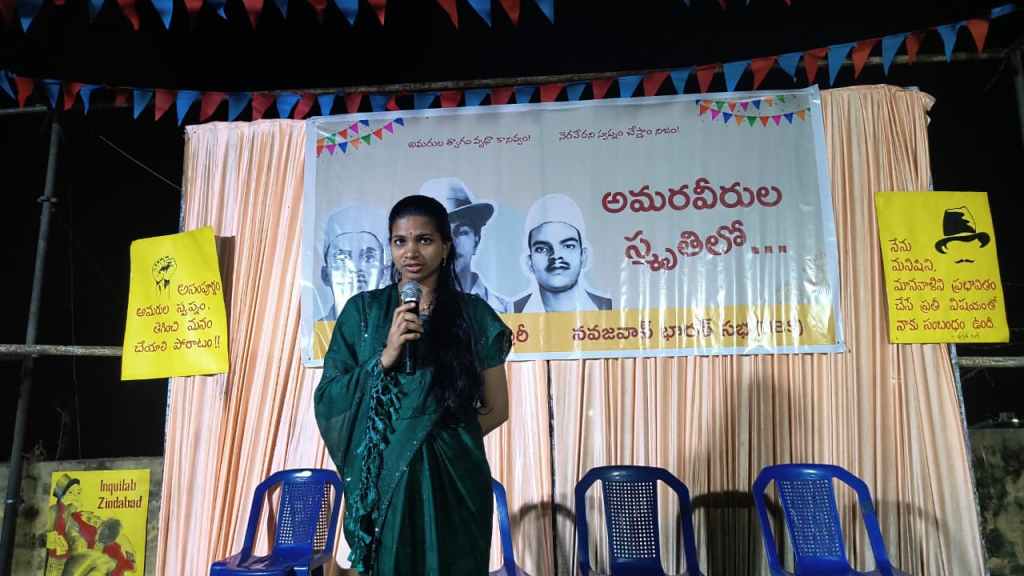
Aruna ma’am largely spoke about the same issues—how women need to at least learn reading and writing, not just to ward off the injustices committed against them by society, but also to take part in understanding and leading change.
When Aruna ma’am was speaking, I tried to spot her ninth-class daughter, Junnu—I don’t know her real name—whom I thought would look very proud. I couldn’t spot her at the time. Yet, I know one thing: I don’t know who should be prouder of the other among this mother-daughter duo.
For this meeting, which Teja akka, Aruna ma’am, and Sujan led, several posters and art pieces were hung around. On both sides of the audience arena, digital posters illustrating the important life events of the trio were hung. Half of them were designed by Sujan, and the other half by Nina, the daughter of J.P., the godfather guy. They were awesome. They were beautifully designed. And apart from these digital posters, there were five or six hand-drawn art pieces hung here and there. They were all breathtakingly beautiful and powerful.
At first, I did not think much about them. I guess I was sure they were painted by someone professional and stuff. Only later did I know that they were painted by this Junnu, this ninth-class girl (she’d be protesting, “I am in tenth now!”—whatever!), and wow!
Just because I am here, I need to take a moment and reflect on Teja akka’s comment that day. We were talking about how beautiful the works done by Nina and Junnu were, and Teja akka simply said, “You know, generally, comrades do not involve their children in these activities. They don’t like to expose their children to all of this.” She probably meant the poverty and the people they deal with. “But here, it is different. Look at all these kids,” she said. She was so happy, and it showed on her face—not just happy, but proud in a way.
The children here are independent. They come, attend, and participate in these social gatherings on their own—of their own free will, for whatever that’s possible for people of their age. Nina was there even before J.P. Teja akka thought J.P. might not be there, for he might be caught up with so many other things he organises. When he showed up late in the evening, after dark, she saw him in a whoop and made a witty remark which I enjoyed but do not remember.
So, Nina was there on her own accord, Junnu was there before her mother, and Che Bhagat, another ninth-/tenth-class kid who is extremely active in all activities of N.S.P. and the library, was there too and was leading from the front. These kids are amazing. I looked at them, and I couldn’t make sense of it.
They attend all important socialist, Marxist book clubs, learn the science of Marxism, follow and understand politics, discuss and debate culture—and they are not for real! Damn! They understand international trade, bilateral treaties, rupee-dollar inflation, the U.S.–Iran war, labour laws, and farmers’ protests in Punjab/Delhi better than 98% of literate adults in the world. They are that good—so good! Maybe it is in their hands that the revolution is safe. Viva la revolution, yep!
After Aruna, or after Teja akka, Sujan spoke at last. This guy talks like the Buddha. Except for the times he roars “Inqilab Zindabad!” in a goosebumps-giving manner, he speaks like the Buddha! With him, there is nothing like our ideal idea of these aggressive revolutionaries. He’s so soft-spoken, and he sounds so sincere that even the most sceptical of people are bound to listen to him and believe in his cause. It feels like, “If a person this sane and controlled believes in this, there should be something about it.” And I love that.
He came up, and all the audience knew him very well because he keeps up the good work with the library, along with dedicated and well-learned comrades like Pooja and others. He spoke about the lives around them and how all of us, with the inspiration of the trio, can change our lives too. He spoke about the importance of this and that, and I don’t remember the precise words, except that his voice made me feel inspired from the inside of my bones, in a very sincere way. Ha! I wish I had come around to writing this earlier; I could have remembered the words. What a loss!
Apart from the speeches, two specific things were very, very interesting about the meeting—for me.
The first was Ajay sir’s magic show. Ajay sir is Che Bhagat’s father and a hardcore atheist. The other day, J.P. and Teja akka were discussing the attitude of an orthodox Marxist who failed to question the methods of Lenin, and then J.P. said, “Why not Lenin? We will question anyone. Even if it is Lenin, we will. Even if it is Marx, we will question if the method proves wrong. Is Lenin a god?” J.P. made the statement in the sense that God is someone who refrains from being questioned. There was Ajay sir somewhere in the room. “Even if it is God, we will question,” he said. “We will question him, especially if he’s a god.”
An atheist, and for some time a passionate leader of some group that professed science and fought against the darkness of religion and the idea of God, Ajay had come into Marxism after understanding that it is capitalism that is his true enemy, and that religion, superstition, and the darkness spread by it are but justifications of the economic inequality that is rampant in current human society. I don’t know who conferred this enlightenment upon him, but Ajay reminds me of myself.
The journey from a strong theist, and then moving towards atheism through the confusing clouds of agnosticism, and then completely giving up on the futile debates of “God or not” to focus on the real problems of the world is a familiar journey. When I was stuck being an anti-religion warrior, it was J.P. who talked sense into me. It did not take him much time to do that. Later, he made it look like it was because I was smart and grasped the arguments before he made them. But I guess I know that’s not the case. He is just a stupendous argument maker. Stupendous!
So, Ajay sir’s magic show was very entertaining—more educational than entertaining. That was the idea. He had shown various tactics that religious seers or black magicians use to cheat people. He had shown how to make a casual-looking coconut bleed; how to make seemingly normal leaves burn up with casual drinking water; how to burn up “sacred ingredients” precisely when someone’s name came up; how to enlarge a balloon till it burst just by spitting some water into it; and many more. He had explained in a fun way how people could be fooled by these simple tricks if they were not careful and believed in everything they saw.
I enjoyed it a lot. Even the audience responded very well to this. There were lots of claps and laughter. The kids who helped Ajay demonstrate were all intuitive, funny, and smart. They brought life to the performance and made it very sweet.
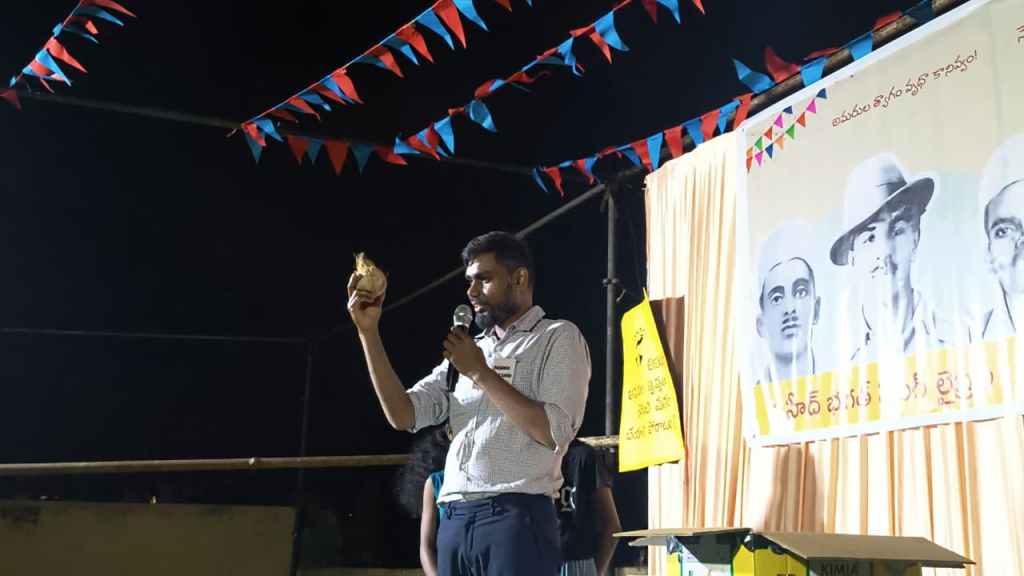
Now is the answer to the question most of you are beating yourselves up with: “Okay! Everyone’s adding value to this. Apart from being the narrator, what value did you add?” Not much, but with the same kids, under the supervision of Sujan himself, we had them stage a play. A simple play, written by playwright Sujan and assisted by me. Yes, you can call me the director of sorts. Yes, pretty lame at that, but yeah, I did what I could do best: bring fun to the table.
The play goes something like this (all characters were played by the students who came to the library):
Three men, presumably fishermen, meet on the way back from fishing—their daily quota of work—and have a casual conversation about how tough life has been lately after fish started to move further into the ocean, leaving them no other way than to go deep into the sea and stay there for at least three days or more. One of them reads a newspaper article announcing more factories at the bay, which worries them further, as the chemicals and the waste produced by these factories make life much harder for them. Because of all of this, they have to risk their lives just for a livelihood, meeting accidents every other day and losing so many precious lives.
One of the fishermen remarks that it is hard at home, too, to convince his wife and family to let him go fishing. Then they depart, sadly.
In the second act, we see the house of the man who had remarked. His wife is ever anxious about her husband and their family. She urges him to give up fishing and look for some other work. The husband, understanding her concern, gently rejects her idea, saying that fishing has been their generational means of living and, one, he can’t just give up on that, and two, their lives will only get tougher if they become identity-less labourers in the city. Understandably, the wife is upset with him. The five- or six-year-old son comes to his mother’s aid and adds a sentimental angle, explaining how he too, along with his mother, is always awake at night and anxious all the time when the father is off fishing.
The first two acts are very organic and my favourite. The next act has us witnessing a conversation between the fishermen and some shallow NGO beach clean-up guys. It becomes a little didactic there, but the message is loud and clear: one cannot save the ocean by picking up a few plastic covers off the sand. Of course, that might be good because it makes the beach “look” clean, but it really doesn’t help at all. A quirky, energetic fisherman explains in a funny way how all the cleaned-up waste reaches the exact same shore within no time.
The play ends with all of them pledging to understand the ocean better, understand the lives of people directly depending on it better, and to make the ocean clean and safe together. The pledge was my idea, just letting everyone know! That’s all.
The girl who played the wife was awesome; so were the husband, the quirky fisherman, and the main beach clean-up guy. The play, at least in my opinion, was a huge success. People like Teja akka think otherwise. I will tell you why!
The thing was that there were no mics, and Sujan came up with the idea to tie the mic to an intimidating stick (with which Avinash was always on the go to thrash any RSS goons who might try to crash the meeting). The plan was to oscillate the mic-stick between the actors, and I volunteered to be the mic-guy. I did a GREAT JOB! Teja akka doesn’t think so. Not that it changes the facts, but yeah!
And the second drawback was that I was a bad director. I had no idea of different Telugu accents/slangs, and only when Teja akka pointed it out did I realise that I had no understanding of the body language of women based on class. She is awesome. I love her, and she makes me understand how bad I am. Perfect sister. God’s gift!
But that did not beat me up. Being a bad director and bad mic-man did not affect me. Lasa did. Lasa is a friend whom I met first on the singing competition day, and it felt like I had known him forever. On the meeting day, it was with him that I spent most of my time. He perfectly got my rotten sense of humour, which left many others annoyed and lost. Most of them could not understand whether I was joking or serious. Even if they got that, they did not understand my references, and it was embarrassing, frankly.
On that single day alone, by Lasa’s side, my sense of humour deteriorated so badly that I made a peeing joke before all the girls, and it was pretty embarrassing. Even Lasa mumbled near my ear, “Your humour’s deteriorated, came down from days to minutes. So bad!” It was true. It was bad. I try to tell myself that mine is dry British humour, but I know it is not. It is just bad. Creative, yet bad. Consolation!
Even though I spent most of my time with Lasa, I do not know much about him except that he completed his BBA and is in a bad crunch. But his aura is unmatched—an aura farmer, at least. He used to be the one who read the text in our book club’s weekly reading day. Lately, democracy took hold and spoiled everything there, but yeah, even now, when he does read, he’s awesome.
Anyway, he took all the pictures of the meeting, and I was expecting myself to be in an excellent picture as the mic-holding director of sorts. He did not click one. Not even one. Underrated effort, that.
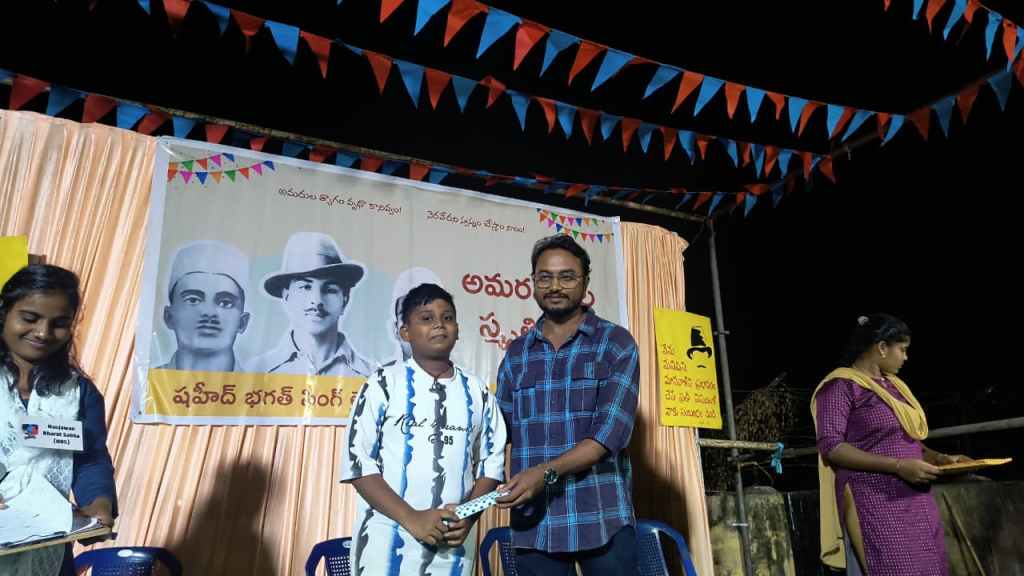
Anyway, coming back to the meeting, after the program, the prize distribution commenced, and I was summoned onto the stage to give away the prizes for drawing and some other competitions. I was on the stage and wondered why I was giving the prizes. I do not even qualify to be there. These people set up a library in this colony, providing kids and elders with education, striving night and day to spread awareness about the world, inspiring them and implementing activities, and conducting these programs and then these competitions—I just don’t know why I was there.
At the same time, I knew one thing: no one, especially J.P. or Teja akka, is an idiot. They neither simply give in to a pompous display of friends nor to an emotional connection. If I was there, there was a reason: if my past actions did not put me there, my future actions are supposed to be influenced by it.
It was a message to me: “Be an active part of this. Live up to this.”
Sure thing, J.P., sir. (Salute)
Just the way Avinash had anticipated, the RSS people had come. Sujan tried to talk to them, while some of the local people stood in support of us. There was a thin, short, bald guy who wore white, who started to question Sujan about why Ajay’s magic show only focused on Hindu superstitions and not on Christian and Islamic superstitions and their fakirs and pastors. He started to lecture on how Christian pastors do this and that, while Sujan tried to pacify them, explaining that it was not about any religion but about how everyone exploits common people.
It went on for a while, and in the meantime, I got to know that there had been a bigger fight last time, and someone ended up bleeding from wounds, and Sujan was even held at the police station. I do not know how much of this is true, and I haven’t tried to clarify it.
I enjoy spending time with Avinash. He is THE GUY! FIRE GUY! THE FIRE GUY we all need. Six feet or so, in his mid-twenties, he’s smart, playful, dedicated, and FIRE! He had spent a year or so in RSS training, and he was vexed with the hypocrisy of all of that, and from there he brought two things: the fire of revolution and the stick I mentioned earlier. He’s fearless and even reckless. He doesn’t bother anyone much and is up for risk anytime. Avinash is the death stone where hypocrisy is chopped. Okay, okay, I guess that’s a lot now.
By the end of it, J.P., Teja akka, and others created some hurry, rush, and worry, and forced these RSS guys to leave the arena, claiming there were children with us with whom we all needed to go home, and it was already around 10:30 at night. They took a few phone numbers and left.
We sorted things out quickly and were on the move. We were to carry all props and people to N.S.P.’s office or something nearby. I carried this and that for two rounds and dropped them there. When I came for the second or third round, everything had been cleared. Avinash, along with a guy named Choonash (I haven’t got one thing about him—he’s so silent, he could not exist!), had cleared it all. We started picking people up, and I picked Pooja up, and we went to the place.
When I was there, I saw something extremely beautiful. All of them were outside the apartment building, on the road, in the middle of the night, in the middle of the street—all of them. Pooja, Nina, Che Bhagat, Avinash, Junnu, Ajay, Teja akka, Choonash, Usha, and all of them. They were sitting there and having fun. Avinash, who till then had set the meeting on literal fire with his thunderous slogans of “Inqilab Zindabad” and “Manam evarante emani cheptham? Shahid Bhagat Singh varasulantam!” and others, was just there, teasing Bhagat along with Junnu about a girl he had had a long phone call with. They were having brutal laughs at his expense.
Nina found a street dog, sat beside it, and started to pamper it as if it had been hers for the past five years. Teja akka and Choonash went to get petrol, and I was jealous that I couldn’t go. Bhagat was trying to tell me what had happened with this girl and how Junnu and Avinash were trying to make something out of nothing. Everyone was saying something or the other, everyone laughing about something or the other; everyone seemed content and so strongly bonded—they had each other and were unafraid of anything.
In the middle of that night, at that moment, I realised: these are not just “revolutionaries” or something. These are sweet human beings, banded together, believing in the necessity of changing the world and in the necessity of bringing equality to everyone. In a world filled with defeatists and purists, these are a band of people struggling against all forces, large and small, believing in every building block, large and small, cutting their way through time, trying to found a better future today.
I’d like to add something like, “with nothing but their faith, willpower, and blah blah,” but J.P. will be like, “Marxism as science backs this; this is not just faith.” So boring. No theatrics.
That night, after helping them with water bottles, I started home. On the way, I stopped and sat by the beach at the viewpoint. I wondered about how I had landed among all these people. I wondered what all of that had really meant. I wondered what that library could truly achieve in that place and what an asset it could be for those underprivileged children. I wondered about Bhagat Singh. I wondered about Sujan, J.P., and Teja akka. I wondered about what I was doing among all of this.
While all sound faded away, Sujan’s voice from the meeting rang in my ears. He was tearing his throat, and his voice was audible for kilometres together. “Inqilab Zindabad!” he roared. My blood surged. With him, I too did. “Inqilab Zindabad!” First, doubtfully; by the end, heartily.
Inqilab Zindabad!